
Charging Powder into a Pressurized Glass-Lined Reactor Through a Split Butterfly Valve
Most reactor charges are made with the vessel at atmospheric pressure. When a charge has to be made under pressure, the split butterfly valve can hold its seal, but the container, the nozzle and what happens after the valve closes all have to be planned for it.


The Question Behind Every Reactor Charge
Solids additions are where API synthesis meets the operator. Seed crystal, intermediates and actives go into the reactor as powder, sometimes into a vessel that has been inerted or is running above atmospheric pressure. When the powder is potent, the addition also has to be contained.
Reactor charging is one of the most common uses for a split butterfly valve. The question engineers ask once the valve is on the drawing is a good one: if the vessel is under pressure, what happens to the container when the charge is done and the valve closes? Is it left pressurized, and how do you get it off safely?
The answer starts with a question of its own, and it is the one most worth settling first, because the usual answer to it makes the problem go away.
Is the Vessel Actually at Pressure During the Charge?
A reactor’s design pressure and its pressure during a solids addition are different numbers. ChargePoint’s experience is that powder transfers into a vessel are usually made with the vessel at atmospheric pressure.
For an atmospheric addition, the options include:
- Flexible ChargeBags, single-use and with no pressure rating, docked to the reactor’s valve for the addition and discarded after
- Low-pressure plastic containers in HDPE or LDPE, lighter to handle than stainless steel
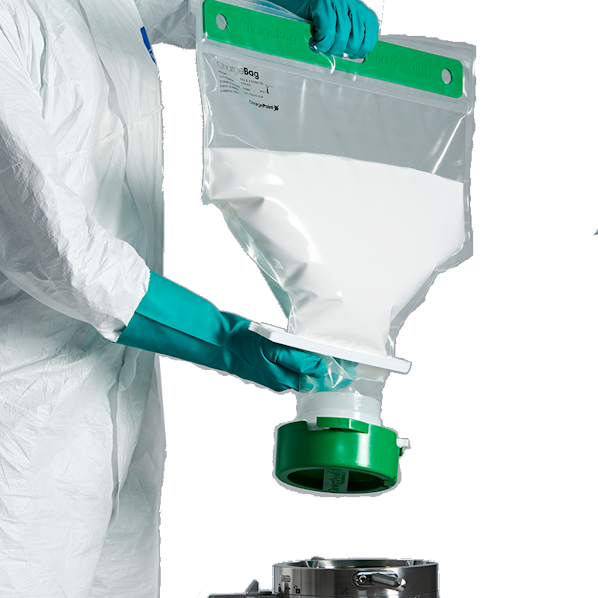
Charging at atmospheric does not mean the reactor needs a second valve below the charge valve to go back to pressure afterwards. ChargePoint does not normally treat the active valve alone as a pressure hold, but it does once a mating component is fitted, such as a pressure plug, a pressure-rated sight glass or a pressure-rated cleaning cap, within the rating of whatever is fitted. An isolation valve below is only needed to change containers while the vessel is at pressure.
Only when the process genuinely needs the addition made with the vessel held at pressure does every part of the charge path have to be pressure rated. That is the case the rest of this article covers.
What Holds Pressure, and When
A split butterfly valve has two halves. The active half mounts on the reactor nozzle. The passive half is on the container. Neither half can open unless both are docked; when they are, the two disc halves lock into one disc and the active unit drives it open. On undocking, only faces that were sealed against each other are exposed, which is where the containment comes from.
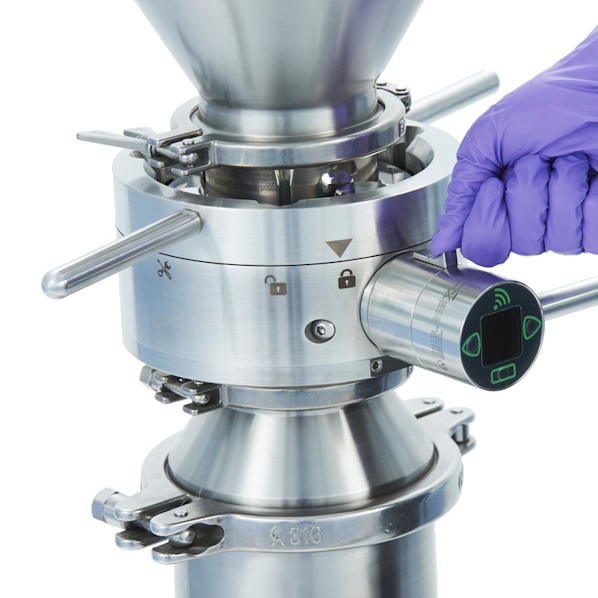
For a pressure-rated transfer, ChargePoint recommends three pressure-rated parts working together: the active valve, the passive valve, and a stainless steel ChargeBottle M or MX as the container. The M is rated up to 6 bar and full vacuum (check the rating for the volume). Together they hold pressure as one assembly. From there the sequence is predictable:
- During the charge. Once both halves open, the container and the reactor are one space. The container equalizes with the vessel pressure as the powder flows down.
- When the valve closes. The container is now at vessel pressure. ChargePoint’s recommendation is to leave the container and passive docked; the assembly holds that pressure.
- When the container has to come off. This is the step that needs a plan. Once the passive is removed, the active valve on its own is not normally treated as a pressure-hold item. It holds pressure when something is mated to it: a passive, a pressure plug, a sight glass or a wash cap.
So a charge that needs more than one container per batch has two workable answers. Bring the vessel back to atmospheric while the empty container comes off and the next one goes on, or put an isolation valve below the active valve so the reactor is closed off independently while containers are changed. Which one fits depends on the process step, and it is a decision for the P&ID, not for the operators on the day.
Getting the Pressure Out of an Empty Container
An emptied ChargeBottle that comes off at vessel pressure will lose that pressure on its own over time, because the tri-clamp and valve connections have a gradual leak rate. If the container has to be equalized faster, fit a vent valve and filter on one of the bottle’s optional connections. On the ChargeBottle MX that is the optional purge or vent port, the same connection that is typically used for a spray connection or a gas flush when charging. Specify it with the containers, not after the first batch.
The Rating Falls as the Valve Gets Bigger
Valve size usually follows the transfer: small bores for small manual additions, large bores for bulk transfers. Under pressure, size has a second effect. ChargePoint’s datasheet ratings for the coupled valve (Series 2 at DN50, Series 3 above) step down as the bore goes up:
| Valve size | Coupled pressure rating (published) |
|---|---|
| DN50 (2″) | Full vacuum to 10 bar (145 psi) |
| DN100 (4″) | Full vacuum to 10 bar (145 psi) |
| DN150 (6″) | Full vacuum to 6 bar (87 psi) |
| DN200 (8″) | Full vacuum to 3.5 bar (42 psi) |
Set those beside the reactor. 3V Tech’s DIN glass-lined reactors are designed for full vacuum to 6 bar, and its ASME reactors for full vacuum to 100 or 125 psi depending on the model. A DN200 valve is a fine choice for an atmospheric charge into any of them. It is not a match for a charge made at the top of that range. Check the number against the pressure the vessel will actually see during the addition, and confirm the rating for the specific valve and options with ChargePoint.
The Reactor Side: Which Nozzle, and What It Gives Up
On a glass-lined reactor, the active valve goes on a top-head nozzle, so the charge point is part of the vessel design. 3V Tech’s reactors carry glass-lined nozzles with loose backing split flanges, to DIN PN10 on the DIN range and ANSI B16.5 on the ASME range. ChargePoint’s valves are available with PN and ANSI flanges as well as tri-clamp, so the mount is a flange-to-flange question that is easy to settle at design and awkward to settle after the vessel is built.
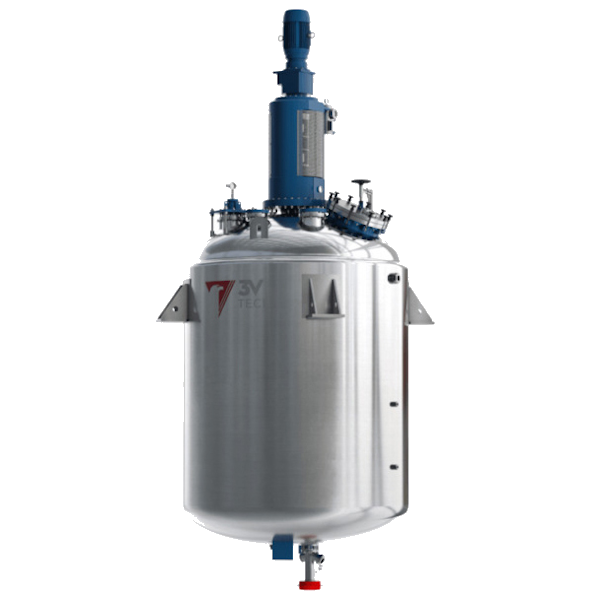
Three points come up on almost every project:
- Plan the charge nozzle with the nozzle schedule. 3V Tech’s reactor accessory list includes a powder charging device and a fast closing device alongside the probes, dip pipes and sampling options that compete for the same top head. Decide early which nozzle carries the solids addition.
- Do not lose the sight glass. 3V Tech’s glass-lined reactors include a sight glass and light glass as standard on most models. On an existing vessel, the free nozzle is sometimes the one that carries the sight glass. ChargePoint offers a pressure-rated sight glass assembly for the valve, so the charge port can double as the view into the reactor.
- Match the area classification. 3V Tech’s AE glass-lined reactor, for example, is rated for ATEX zone 1 and zone 21, inside and outside the vessel. ChargePoint’s automatic valves carry ATEX certification and manual valves are supplied with a hazard assessment certificate; single-use bags and passives have their own zone limits. With a solvent in the vessel, check every part of the charge path against the zone, not just the valve.
Materials Follow the Chemistry
A glass-lined reactor is chosen because the chemistry is aggressive: acid-service reactions where stainless steel would fail. The charge valve sees the same vessel atmosphere. ChargePoint builds the valve body and disc in 316L or Alloy 22, with EPDM, FKM or FFKM seals chosen for chemical compatibility. When the reactor is glass-lined for corrosion, the valve’s wetted materials deserve the same review, and that is a conversation to have with both manufacturers at once.
Containment is chosen the same way it is for any other charge point. The standard PharmaSafe valve is rated to operator exposure down to 1 µg/m³ with no extraction; the pro version adds a low-volume extraction system to reach 0.1 µg/m³; the excel version goes below that, to nanogram levels.
Cleaning Between Campaigns
The valve is cleaned with the reactor in mind. A traversing wash lance can pass through the open valve into the vessel, cleaning the valve’s sealing faces and the vessel connection together, and a spray cap on the active valve cleans that half in a sealed environment. The valve breaks down into few parts for campaign cleaning in a parts washer. On a multi-product reactor, decide which of these the cleaning procedure will use before the valve is specified, because the choice changes the options ordered with it.
Related Pages
- ChargePoint PharmaSafe Split Butterfly Valves: the containment valve range
- ChargePoint ChargeBottle Rigid Containers: the stainless and plastic containers
- ChargePoint ChargeBag Single-Use Containers: for additions at atmospheric pressure
- 3V Tech Glass-Lined Reactors: DIN and ASME reactor ranges
- Cleaning Glass Reactors and Filter Dryers: the cleaning side of the same equipment
Planning a Contained Charge into a Reactor?
MHS Pharma represents 3V Tech and ChargePoint Technology across the Northeast United States. We can help you work through the charge sequence, the valve size and the nozzle with both manufacturers at the same table.
Contact MHS Pharma