
Downflow Booths
Extract Technology Containment Booths from DEC Group
Overview
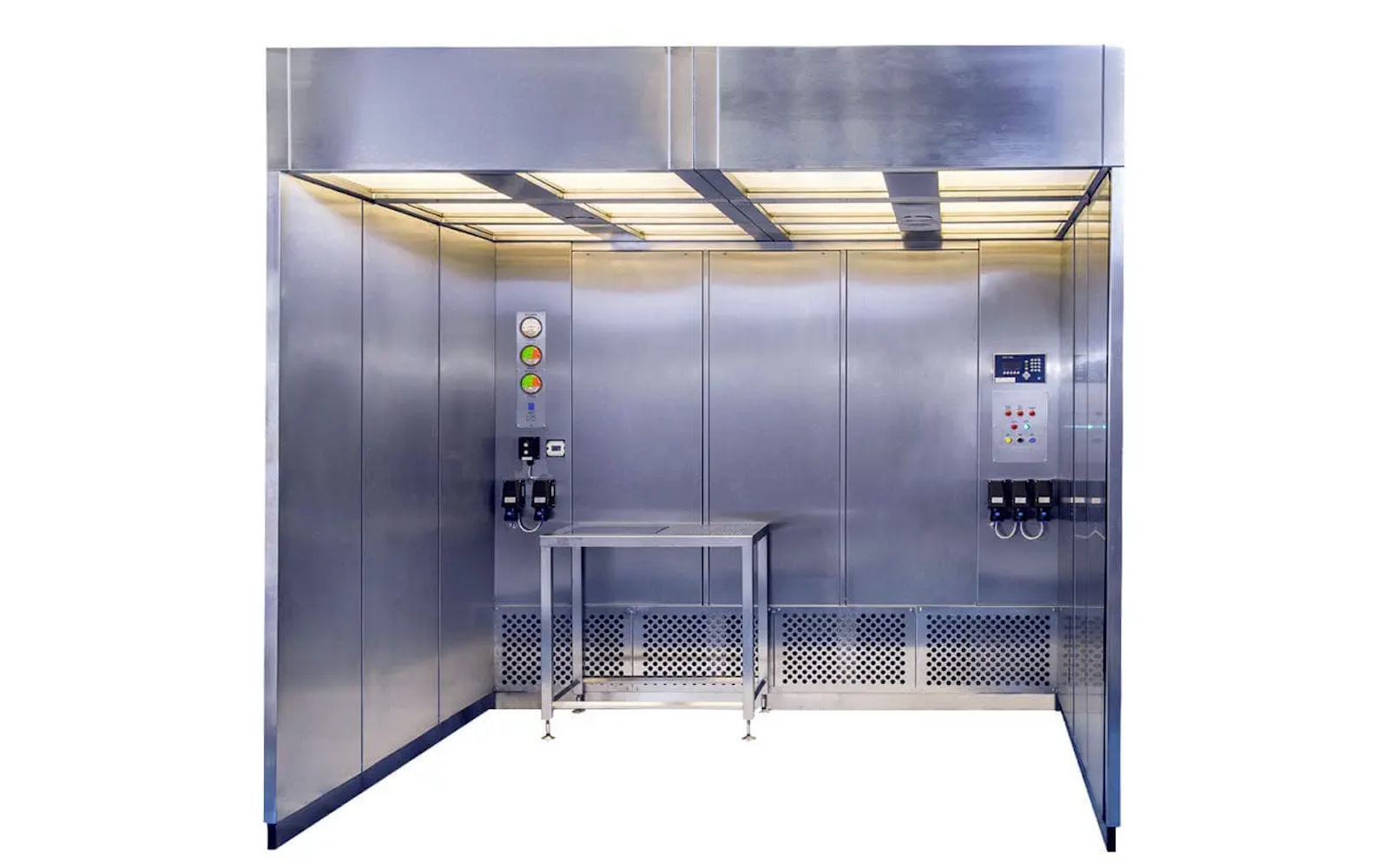
DEC Group’s downflow booth range draws on over 25 years of design heritage, originating from the Extract Technology acquisition. These open-front booths protect operators during manual powder handling by directing clean air from the ceiling plenum downward, pushing respirable dust away from the breathing zone and into high-efficiency filtration at low level.
Downflow booths are the workhorse of pharmaceutical dispensing suites: used wherever operators handle powders that present an occupational exposure risk but don’t require the full enclosure of an isolator. DEC is Swiss-headquartered with manufacturing in Poland, UK, and the US.
Principle of Operation
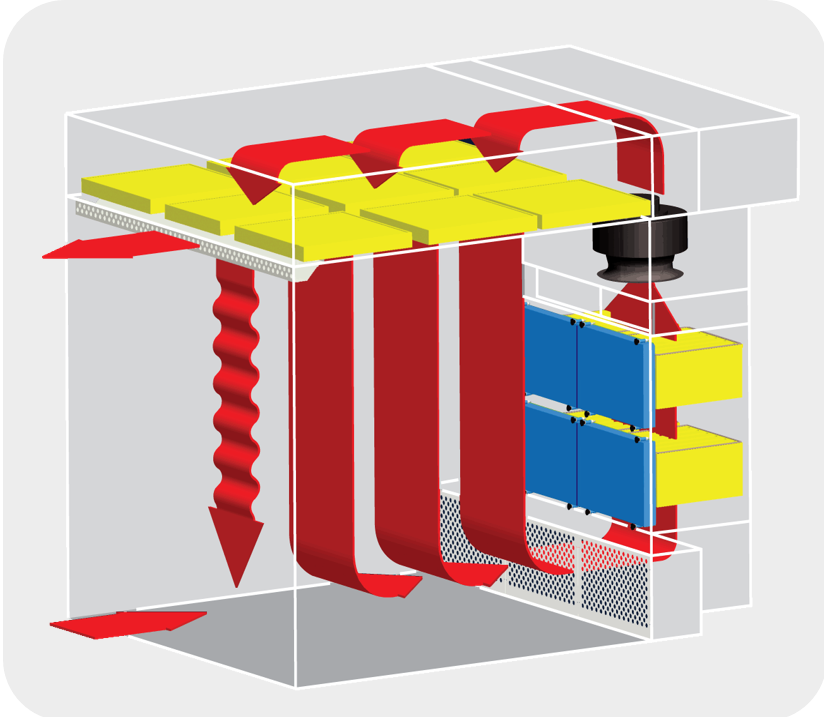
- Clean air from the ceiling. Filtered air leaves the ceiling plenum and moves down through the whole work zone.
- Dust carried down and away. The downward flow pushes respirable dust generated at the work surface down and away from the operator’s breathing zone.
- Captured at low level. High-velocity exhaust grilles at low level draw the dust-laden air out of the work zone.
- Filtered. The air passes through fine dust filters and HEPA filters in the technical area behind the booth.
- Recirculated, slightly negative. The fan returns the clean air to the ceiling plenum. A small amount is exhausted, which keeps the booth under negative pressure relative to the room.
Because the protection comes from the airflow pattern, how the booth is used matters as much as how it is built. Where the operator stands, where the scale, drum and other equipment sit, and how big the booth is relative to the task all shape how well the air does its job. That is why a booth is sized and laid out around the actual operation, not picked from a catalogue by width alone.
Key Specifications
| Operator Exposure | 100 µg/m³ (task duration), improvable to below 10 µg/m³ with containment screens |
| Widths | 1.5 m to 6.0 m |
| Safe Working Depth | Up to 2.2 m |
| Containment Zone Depth | L (2,300 mm), LS (1,800 mm), LX (1,200 mm) |
| Internal Height | 2,300 mm (standard) |
| Overall Height | 2,750 mm (standard) |
| Technical Area Depth | 1,050 mm behind the booth for fans and filters |
| Materials | Epoxy coated zintec, 304/316L stainless, or combination |
| Noise | <70 dBA (PharmAir range) |
| Utilities | 3-phase + neutral + earth, customer supplied |
Every booth comes with a high-efficiency fan and drive with automatic volume control, magnehelic pressure gauges, and a rear-mounted control panel for lights, motor, sockets and start/stop.

Containment Levels and the Next Step Up
A standard booth is the right tool for a wide range of compounds. When the exposure limit drops, the same booth can often be upgraded before anything larger is considered:
| Configuration | Operator exposure (task duration) |
|---|---|
| Standard downflow booth | Around 100 µg/m³ |
| Booth with barrier screen | Below 10 µg/m³ |
| Booth with barrier screen and strict operating procedures | Below 1 µg/m³ achieved in a sampling facility installation |
A barrier screen is a transparent rigid or flexible panel with glove ports, positioned between the operator and the process inside the booth. It can be retrofitted into an existing booth, folded to the side wall, or removed entirely when the booth goes back to handling less potent material. Where a task needs more than a screened booth can deliver, DEC’s Isocharge hybrid booth and its isolators are the next steps.
Key Features
Controlled Downflow Airflow
Clean air from the ceiling plenum pushes respirable dust downward and away from the operator’s breathing zone. High-velocity exhaust grilles at low level direct dust into fine dust and HEPA filters.
Containment Screen Upgrade
Standard booths can be upgraded with rigid barrier screens featuring transparent acrylic panels and glove ports, taking operator exposure below 10 µg/m³, and below 1 µg/m³ with strict operating procedures.
Glassware Containment Booths
Modular enclosed booths designed for reactions, distillation, and kilo lab work. Achieves <10 µg/m³ with 100% fresh air supply, hinge-open safety glass doors, and negative pressure enclosure.
Flexible Configuration
Options include cooling systems, downdraft workbenches, safe-change (BIBO) filter housings, ATEX upgrades, lifting and tipping systems, airlocks, roller conveyors, and rapid doors.
Case Study: A Pharmaceutical Sampling Facility
Extract Technology replaced 1990s-era containment equipment at a large pharmaceutical manufacturer with a 27 m² sampling facility built around a downflow booth:
- Unidirectional airflow at 0.5 m/s from the ceiling plenum in a single-pass regime, holding ISO 5 conditions
- Rigid barrier screen with a transparent acrylic panel, two glove ports and a five-axis articulating arm
- Operator exposure below 1 µg/m³ (task duration) with the barrier screen and strict operating procedures
- Independent personnel and material airlocks, with a remotely driven transport truck on a rail track for materials
- Low-level and high-level exhaust, a local HVAC system, and HMI monitoring of pressure and airflow
What to Settle Before Specifying a Booth
- The task and the material: dispensing, weighing or sampling, and the exposure limit of the most potent compound the booth will see
- The largest load: drums or pallets that have to fit in the containment zone, which sets width and depth
- The room: ceiling height for the 2,750 mm standard booth, and space behind it for the technical area
- Material handling inside the booth: lifting and tipping equipment, downdraft benches, conveyors
- Whether a barrier screen is needed now or should be allowed for later
- ATEX zone, safe-change filter housings, alarms and cooling
Applications
- Pharmaceutical dispensing and weighing
- Powder sampling and manual handling
- Advanced sampling facilities with barrier screen configurations
- Kilo lab chemistry (glassware booth)
- Any manual powder operation requiring operator protection
MHS Pharma, Northeast US Representative
MHS Pharma provides direct technical representation for DEC Group across the Northeast United States. Contact us to discuss downflow booths for your facility.
Get in Touch