
Pharmaceutical Powder Containment
Engineering controls and equipment from OEB 1 to OEB 5, across every step of solid dose and API processing
What Powder Containment Protects
Pharmaceutical powder containment refers to the engineering controls that prevent operator exposure to potent compounds during processing, and that protect the product itself from environmental and cross-batch contamination. Open handling steps such as scooping, pouring, and manual charging create dust and aerosols; contained equipment keeps a sealed barrier around the product through every transfer, milling, granulation, and sieving step.
Two principles anchor modern containment practice. First, risk is hazard times exposure: a highly potent compound handled in sealed equipment can present less risk than a moderate one handled openly, so both the compound and the operation must be assessed. Second, under the hierarchy of controls, engineering controls that remove the exposure at the source are always preferred over relying on personal protective equipment. PPE is the last resort, not the strategy.
The industry’s consensus playbook is the ISPE Good Practice Guide: Containment for Potent Compounds (2022), developed by an international task team whose contributors include engineers from ChargePoint Technology and DEC Group’s Extract Technology brand. It is not a regulation, but it is the reference document pharmaceutical companies use when specifying containment equipment, and the framework below follows it.
Step One: Classify the Hazard. OEB Levels
Every potent compound gets a health-based exposure limit. Where toxicological data supports a precise Occupational Exposure Limit (OEL), that number is used directly. Where it does not, compounds are assigned an Occupational Exposure Band (OEB), and the conservative end of the band drives the containment decision.
| OEB 1 (>1 mg/m³) | Low potency. Effective room ventilation. |
| OEB 2 (0.1–1 mg/m³) | Moderate potency. Local exhaust ventilation and downflow booths. |
| OEB 3 (10–100 µg/m³) | Moderate to high potency. Enhanced extract systems, containment screens, enclosed processes. |
| OEB 4 (1–10 µg/m³) | High potency. Barrier containment: isolators and split butterfly valves. |
| OEB 5 (0.1–1 µg/m³) | Very high potency. Enhanced barrier containment; contained transfer at every interface. |
| OEB 6 (<100 ng/m³) | Extremely high potency. Enhanced barriers with automation; isolator-grade transfer throughout. |
Step Two: Assess the Operation, Not Just the Compound
The band alone does not set the equipment requirement. The guide’s selection framework assesses the exposure potential of each specific operation using three factors:
- Dustiness. Aqueous solutions barely spread; fine, electrostatically charging powders spread aggressively. Energy-intensive steps such as milling raise spread potential further.
- Quantity handled. Milligram-scale laboratory work and 200 kg production charges present very different exposure potential with the same compound.
- Duration. A task measured in minutes differs from a shift-long operation.
Cross-referencing exposure potential against the OEB yields a Primary Containment Strategy (PCS) level, from PCS 1 (effective room ventilation) through PCS 2 (extract-based systems such as downflow booths), PCS 3 (barrier containment: isolators and split butterfly valves), PCS 4 (enhanced barriers), up to PCS 5 (automated processes inside barriers). A parallel assessment sets the room-level secondary containment: separate rooms, negative pressure, and airlocks.
Many companies then define a Design Exposure Limit for the equipment itself: typically 50 percent of the OEL for operations over two hours, or 100 percent for shorter tasks. That is the number the equipment must demonstrably achieve in testing.
Plan From the Inside Out
The guide’s central design principle: optimize primary containment at the source first, then size the secondary containment around it. Strong containment at the equipment level reduces what the room has to do, which means lower air change rates, simpler airlocks and gowning, less stringent finishes, and a smaller environmental monitoring scope. Every step below follows that logic: contain the operation itself, and the facility around it gets simpler.
Containment by Process Step
Split Butterfly Valve Transfer
The split butterfly valve is the guide’s textbook example of contained powder transfer at production scale: dust-free filling and discharging with low operator skill requirements and high automation potential. Two halves, an active unit on the process equipment and a passive unit on the container, dock so that only sealed clean surfaces are ever exposed. ChargePoint PharmaSafe valves achieve 1 µg/m³ without extraction and below 0.1 µg/m³ with extraction options, validated by SMEPAC testing. For sterile processes, AseptiSafe adds vaporized hydrogen peroxide biodecontamination between the docked valve faces, enabling aseptic transfer in Grade C/D areas, and single-use passive valves remove cleaning validation from the container side entirely. For the most potent OEB 5 and 6 compounds, the guide recommends pairing the valve with isolator-grade surroundings, and it emphasizes preventive seal maintenance as the key to sustained performance.
Pneumatic Powder Transfer
Pneumatic conveying is among the highest-containment transfer approaches in the guide because it eliminates open handling entirely: powder moves through closed piping under vacuum, with no scooping, pouring, or manual charging anywhere in the path. The DEC PTS Powder Transfer System applies this principle to connect reactors, dryers, blenders, and packing lines across rooms and floors, including continuous manufacturing lines that need continuous contained transfer.
Isolators
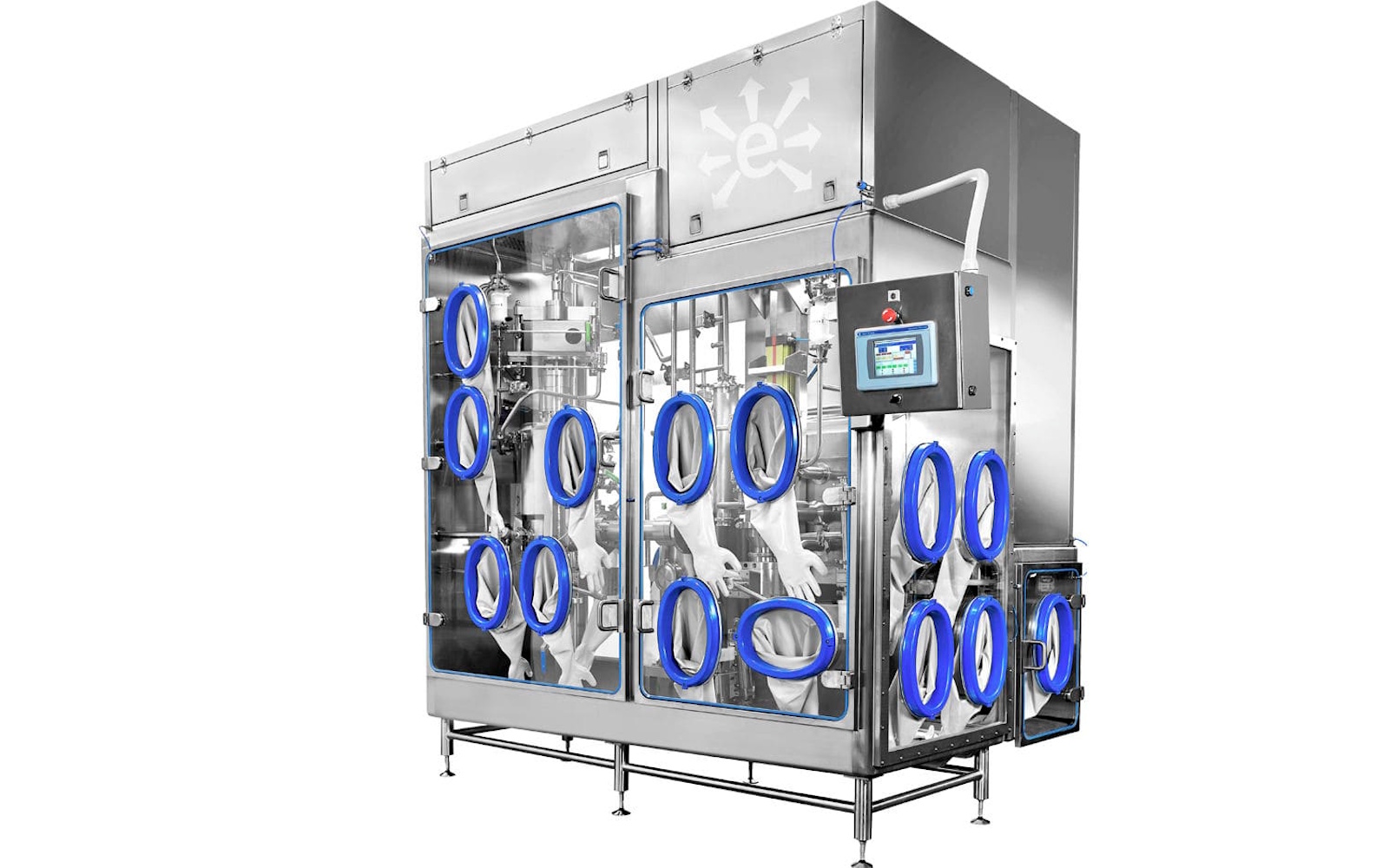
Rigid-wall isolators are the barrier standard for OEB 4 through OEB 6 work: sealed stainless enclosures at negative pressure, HEPA-filtered supply and exhaust, glove-port access, and transfer interfaces engineered into the design. They can integrate WIP and CIP cleaning, hydrogen peroxide biodecontamination, and nitrogen inerting, and good practice calls for ergonomic mock-up studies during design because every isolator is built around its specific process step. DEC rigid-wall isolators cover this range, with aseptic variants for sterile processing.
Downflow Booths
Downflow booths bathe the working zone in HEPA-filtered air moving from a ceiling plenum to a low-level extract, protecting operators during weighing and dispensing. The guide positions booths for lower-potency compounds, with containment screens and barrier enhancements extending them toward OEB 3 duties; above that, barrier systems take over. Used at the right tier, DEC downflow booths offer easy cleaning, open access, and straightforward integration of drum handling equipment.
Contained Milling and Sizing
Milling deserves special attention because the guide explicitly flags energy-intensive operations as high spread potential: milling generates fine, highly dispersible powder, making it one of the highest-emission unit operations in pharma. Frewitt milling systems answer this with high-containment executions to OEB 5 that build the barrier into the mill itself, pairing contained charge and discharge interfaces with flexible or rigid isolation so potent size reduction runs fully enclosed without a separate isolator around a standard mill.
Contained Dry Granulation
Roller compaction is closed by nature, but the guide’s framework applies to the whole operation: charging, discharge, and cleaning all need containment to the same standard as the process itself. The Gerteis Ultra-Pactor is engineered for OEB 5 duty, validated below 0.1 µg/m³, with contained transfer interfaces completing the chain at the hopper and the granule outlet. Our guide on containing a roller compactor from OEB 3 to OEB 5 covers the practical steps.
Contained Sieving
The Russell Compact Airlock Sieve brings check screening to OEL 5, achieving below 1 µg/m³ through a patented pneumatic clamping system, validated with SMEPAC-based testing. For a full-workflow containment strategy it pairs with contained charge and discharge on either side of the sieve, in line with the guide’s principle that an integrated system is only as effective as its weakest element.
How Containment Performance Is Verified
Containment claims are verified, not assumed. The companion ISPE guide known as SMEPAC defines the standard test methodology: surrogate powder run through the equipment under controlled conditions, with samplers in the operator’s breathing zone, at static positions near emission points, and surface swabs at connection faces. A minimum of three test runs is standard, and results are judged against a Containment Performance Target set at or below the compound’s exposure limit.
Testing happens at three points. Vendor test data demonstrates the design’s inherent capability and is the first thing to review before procurement, checking that test conditions match your intended use. Factory acceptance testing can put a containment assessment on your specific unit before it ships. Site acceptance testing after installation is the definitive proof, because installed performance varies with material properties, operator technique, and system wear. As the guide puts it, containment can only be achieved, not installed: breathing-zone results at the working equipment are the numbers that matter most.
Choosing an Approach
Split butterfly valve projects can generally be turned around faster than isolator solutions, and SBVs are low-energy, low-utility installations with high automation potential. Isolators meet the most stringent exposure targets and integrate entire process steps where custom design is needed. The right answer comes out of the framework above: the compound’s band, the operation’s exposure potential, the facility’s constraints, and the design exposure limit the equipment must hit. Containment also has to be maintained, not just purchased: seal wear degrades performance over time, so preventive maintenance and periodic reverification belong in the plan from day one.
MHS Pharma represents the manufacturers above across the Northeast US and can help evaluate containment options against a specific compound and process, including reviewing SMEPAC data against your exposure targets.
Related Reading
MHS Pharma. Northeast US Representative
MHS Pharma represents manufacturers of containment, transfer, milling, granulation, and sieving equipment across the Northeast United States. Contact us to discuss containment for your application.
Get in Touch