
Containment Isolators in Pharmaceutical Manufacturing
How containment isolators protect operators during high-potency compound processing, and what determines the right isolator for a given application.

Why Containment Isolators Exist
Pharmaceutical manufacturing increasingly involves potent compounds: high-potency APIs, cytotoxics, hormones, and antibody-drug conjugates. These materials are effective at very low doses, which also means very small airborne quantities can cause harm to operators.
The industry classifies compounds by Occupational Exposure Band (OEB), which determines how much containment is needed during handling:
| Band | Exposure Limit | Typical Compounds | Containment Approach |
|---|---|---|---|
| OEB 1-2 | > 100 µg/m³ | Common excipients, low-potency APIs | Ventilation, downflow booths |
| OEB 3 | 10 – 100 µg/m³ | Moderate-potency APIs | Enclosed systems, enhanced booths |
| OEB 4 | 1 – 10 µg/m³ | High-potency APIs | Isolators, split butterfly valves |
| OEB 5 | < 1 µg/m³ | Cytotoxics, hormones | Full isolator systems |
At OEB 4 and above, open handling is no longer an option. Downflow booths and local exhaust ventilation cannot reliably achieve the containment levels these compounds require. This is where isolators become necessary: sealed enclosures that physically separate the operator from the product while still allowing work to proceed through glove ports or half-suits.
Rigid-Wall Isolators
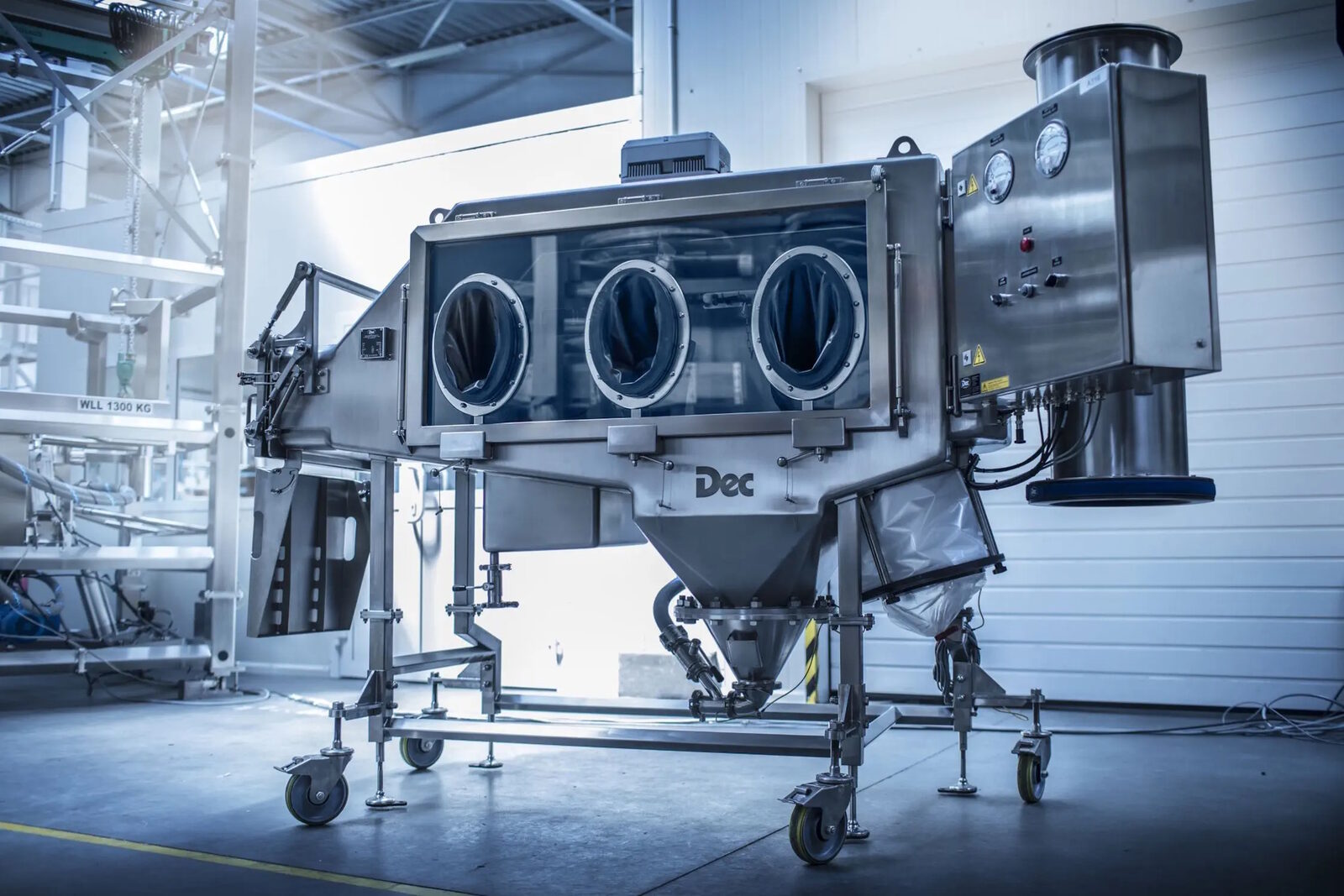
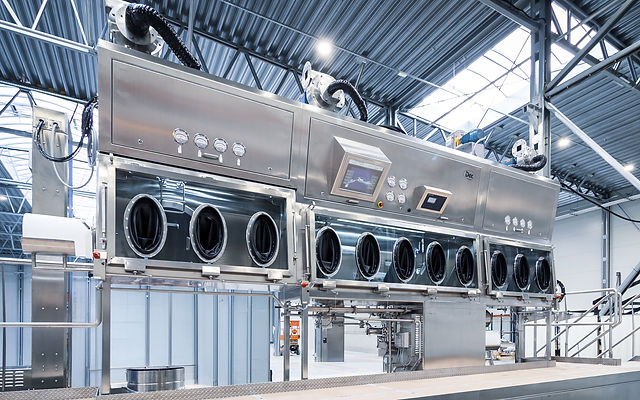
Rigid-wall isolators are the gold standard for high-containment applications. They are sealed stainless steel enclosures operated at negative pressure relative to the room. Operators access the interior through integrated glove ports, and air enters through HEPA filters and exhausts through a second set of HEPA filters.
These systems are purpose-built for specific process steps. A dispensing isolator looks different from a filter dryer discharge isolator, which looks different from a micronization isolator. The enclosure, glove port placement, internal equipment, and transfer interfaces are all designed around the operation being contained.
Common applications include:
- API dispensing and sampling
- Reactor and vessel charging
- Filter dryer and tray dryer discharge
- Milling and micronization
- Pack-off and drum filling
Rigid-wall isolators typically achieve OEB 5 to OEB 6 containment (< 0.1 µg/m³). They support CIP and SIP for automated cleaning between campaigns, and they meet GAMP5 and 21 CFR Part 11 requirements for process documentation and control.
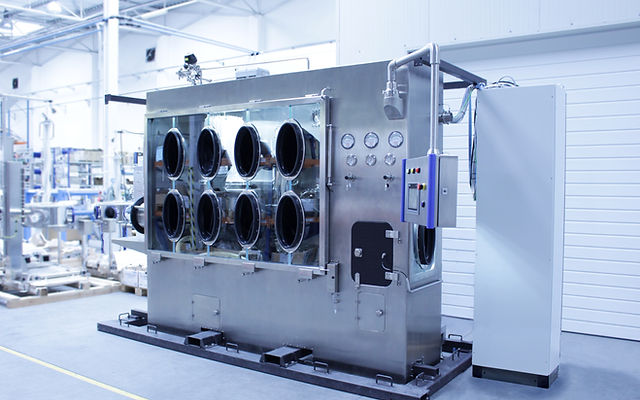
Containment isolator manufacturers design each system around the customer’s specific process, compound, and facility layout. There is no standard catalog isolator for high-potency work. The enclosure dimensions, glove port positions, internal equipment, transfer interfaces, and cleaning systems are all engineered to the application.
Getting Material In and Out
An isolator is only as effective as its transfer interfaces. Every time material enters or leaves the isolator, there is a potential for containment breach. The transfer system must maintain the same level of containment as the isolator itself.
Vacuum powder transfer
Vacuum transfer systems move powder through closed piping between process steps, eliminating open handling entirely. Powder is conveyed from a source vessel into the isolator (or out of it) under vacuum, with no manual scooping or pouring. This is one of the most effective ways to charge an isolator because the entire transfer path is sealed. DEC’s PTS (Powder Transfer System) is widely used for this purpose, connecting reactors, dryers, and other upstream equipment directly to containment isolators.
Split butterfly valves
Split butterfly valves consist of two half-disks: one mounted on the isolator (the active side) and one on the container (the passive side). When docked, the two halves form a single valve that opens to allow powder transfer. When undocked, both the isolator and the container remain sealed. This provides contained transfer with low operator skill requirements and high automation potential.
Rapid transfer ports
Rapid transfer ports (RTPs) use double-door technology originally developed for the nuclear industry. An alpha port on the isolator wall docks with a beta port on the transfer container. Both ports always remain part of a closed system, achieving containment down to low nanogram levels when properly maintained.
Continuous liners
Continuous liner systems use a long tube of flexible film on a carrier cylinder. Material feeds through the carrier into the liner, which is sealed and cut to form contained packages. These are commonly used for discharging product from isolators into drums or bags.
Specialized Isolator Configurations
A general-purpose glovebox is not always the right answer. Several isolator variants have been developed for specific process steps where the standard approach does not fit well.
Isocharge: hybrid booth and isolator
The Isocharge is a bullet-shaped stainless steel chamber that combines laminar flow technology with a gloved visor. It achieves below 1 µg/m³ containment with the door open, which makes it much faster than a traditional glovebox for multi-bag or multi-drum charging operations. The graduated air velocity (0.7 m/s at the opening, decreasing inward) ensures one-way air transfer even without closing the access door. A drum version handles containers up to 150 kg using an integrated drum tipper.
Isocharge fills a gap between downflow booths and full isolators. It provides OEB 4 containment at booth-like speed, with no infrastructure changes required. CIP, integrated scales, and lump breakers are available as options.
Isotube: contained drum emptying
Isotube is a glovebox designed specifically for emptying multiple drums of potent compounds. Drums connect via a rear-mounted tipper with an inflatable seal. Once the drum is sealed to the unit, an interlocked internal door opens for access. Operators remove liners and empty bags manually through front-mounted gloves, and waste exits through a continuous liner side port.
The key advantage over a general-purpose isolator is throughput. Isotube handles sequential drum emptying with contained drum changeover, and it can integrate a lump breaker in the discharge hopper for agglomerated materials.
High containment pack-off
At the end of the process, finished API needs to be packed into drums or containers under containment. The high containment pack-off is a compact glovebox with an integrated continuous liner system. Drums are brought into a pack-off cabin, sealed to the liner head by a pneumatic lift, and filled with automatic weighing to 1 g accuracy. The system achieves OEB 5 containment and eliminates the need for a cleanroom around the filling area.
Inside a Containment Isolator
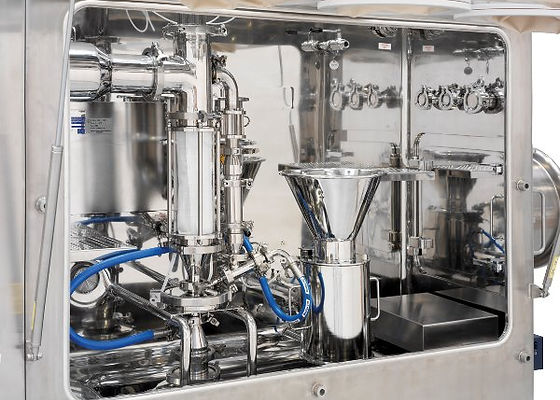
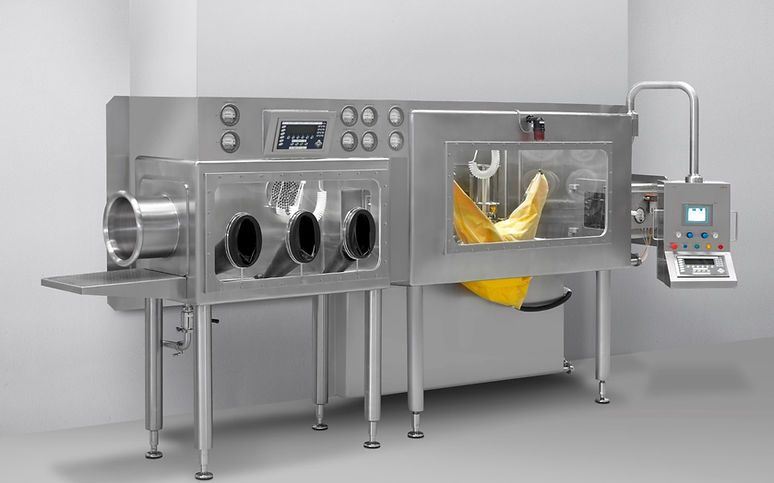
From the outside, a containment isolator looks like a stainless steel box with glove ports. From the inside, it is a fully integrated process environment. Piping, valves, mills, scales, and transfer connections are all enclosed within the sealed space. The interior layout is designed around the specific operation: a micronization isolator integrates a jet mill and classifier, a dispensing isolator includes a scale platform and scoop access, and a discharge isolator positions the glove ports to reach the dryer outlet.
How Containment Performance Is Verified
Containment claims need to be backed by testing. The pharmaceutical industry uses the SMEPAC protocol (Standardized Measurement of Equipment Particulate Airborne Concentration) as the standard method for verifying isolator performance.
SMEPAC testing involves running surrogate material (typically micronized lactose) through the isolator under simulated operating conditions while measuring airborne concentrations at the operator breathing zone and at fixed positions around the equipment. A minimum of three test runs per assessment is standard.
Three types of testing occur during an isolator project:
- Vendor testing: SMEPAC data generated at the manufacturer’s facility under controlled conditions. This is the first data point a buyer should review.
- Factory acceptance test (FAT): Engineering verification at the vendor’s facility before shipment, confirming the equipment matches the design specification.
- Site acceptance test (SAT): Containment measurements performed after installation at the customer’s facility, using surrogate or actual product. This is the definitive proof of performance.
Vendor SMEPAC data is a useful starting point, but it is not a guarantee of installed performance. Actual results vary with material properties, operator technique, room conditions, and system wear over time.
Reducing Costs Downstream
Investing in primary containment (the isolator and its transfer interfaces) reduces the cost of secondary containment (the room and HVAC systems around it). A well-designed isolator with validated containment performance means the surrounding room does not need to be built to the same stringent standards that would be required if operators were relying on ventilation and PPE alone.
This translates to lower requirements for:
- Room air change rates and HVAC capacity
- Airlock complexity and gowning requirements
- Cleanroom wall and floor finishes
- Environmental monitoring scope
The ISPE Containment Guide frames this as “plan from the inside out”: optimize the primary containment at the source first, then size secondary containment accordingly. In many cases, upgrading from a downflow booth to an isolator at a single process step can simplify the facility design around it.
Flexible Film Isolators
Not every application requires a permanent stainless steel installation. Flexible film isolators use LDPE or polyurethane film on an external frame, with welded glove ports or half-suits for operator access. They wrap around existing equipment and achieve containment below 1 µg/m³ without facility modifications. These systems are most common in R&D, clinical trial manufacturing, and campaign-based production where containment needs are temporary or equipment configurations change frequently.
Beyond Manufacturing: Hospital and Clinical Containment
Containment isolators are not limited to API manufacturing. Hospital pharmacies use isolators for compounding hazardous drugs (cytotoxics, monoclonal antibodies) to protect pharmacy technicians during preparation. Clinical trial supply operations use smaller-scale isolators for encapsulation and packaging of investigational compounds. The engineering principles are the same: sealed enclosure, HEPA filtration, negative pressure, and contained transfer. The scale and specific configuration differ based on throughput and compound handling requirements.
Related Pages
- DEC Group: powder transfer and containment systems
- DEC Rigid-Wall Isolators: containment isolator product details
- How to Contain a Roller Compactor: containment applied to dry granulation
- Improving Operator Ergonomics in Downflow Booths: when a booth is the right containment level
Need Help Specifying a Containment Isolator?
MHS Pharma represents DEC Group across the Northeast United States. We can help you evaluate rigid-wall isolators, flexible containment systems, and contained transfer technologies for your process.
Related: our overview of pharmaceutical powder containment covers containment approaches across transfer, milling, granulation, and sieving.
Contact MHS Pharma