
Improving Downflow Booth Containment with a Barrier Screen
A downflow booth protects the operator with airflow alone. Adding a physical barrier at the point where powder is released changes what the same booth can handle.
What the Airflow Does, and Where It Stops
The downflow booth is the workhorse of manual powder handling. Dispensing, weighing and sampling are its everyday tasks, and the principle is simple. Clean air from the ceiling plenum moves down through the work zone, pushes respirable dust down and away from the operator’s breathing zone, and is drawn into high-velocity exhaust grilles at low level. The air is filtered and recirculated, with a small amount exhausted to keep the booth under negative pressure.
That works well, and for a lot of compounds it is all the containment the task needs. But it has a limit that comes from the design itself: the operator and the powder share the same air. Nothing physical separates them. Protection depends on the airflow pattern holding up while a person moves, reaches into a drum and scoops, and in practice it depends heavily on where the operator stands, where the equipment sits and how the booth was laid out.
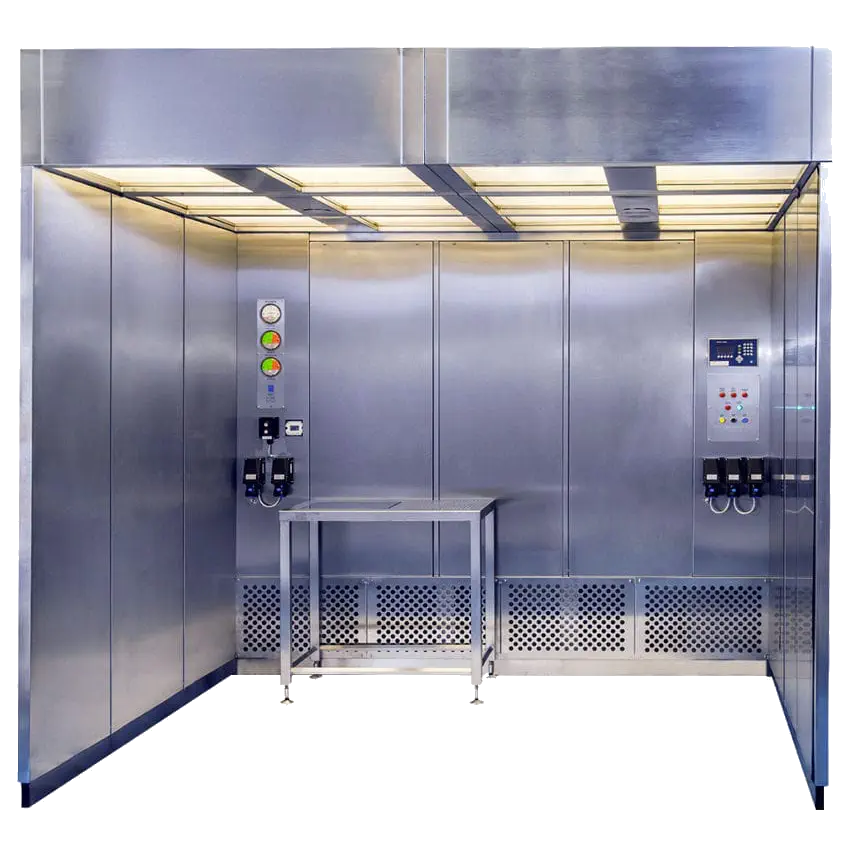
A well-designed standard booth typically achieves operator exposure in the region of 100 µg/m³ over the duration of a task. When a new compound arrives with a lower exposure limit than that, the usual first reaction is to assume the booth is no longer the right tool. Often it still is. What it needs is a barrier.
What a Barrier Screen Adds
A barrier screen is a transparent panel positioned between the operator and the process, inside the booth. The operator works through integrated glove ports or gauntlets, so their hands are at the product while their face and body are behind the screen. The booth airflow keeps doing its job around the screen; the screen puts a physical barrier at the point where dust is generated.
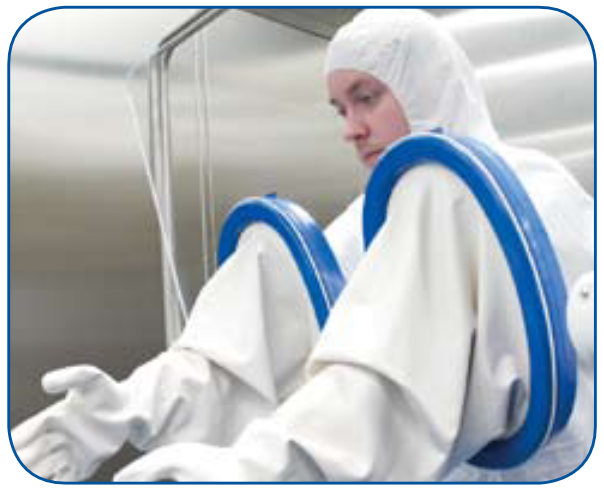
Extract Technology, part of DEC, was the first to integrate local barrier screens into downflow booths, starting in the early 1990s. The published performance figures show the size of the step:
| Configuration | Typical operator exposure (task duration) |
|---|---|
| Standard downflow booth | Around 100 µg/m³ |
| Booth with barrier screen | Below 10 µg/m³ |
| Booth with barrier screen and strict operating procedures | Below 1 µg/m³ has been achieved, depending on the application |
Read that table as an order of magnitude per step. The screen alone takes the booth from the range where moderately potent compounds sit into the range where high-potency compounds are typically banded. The last row is a different kind of number, and it is worth understanding before anyone writes it into a specification.
The Last Order of Magnitude Is Procedure
The sub-1 µg/m³ result comes from a real installation: a sampling facility where the booth ran unidirectional airflow from the ceiling at 0.5 m/s, with a rigid acrylic screen, two glove ports and a five-axis articulating arm to position it. The equipment was necessary to get there. It was not sufficient. The result was achieved with the screen and strict operating procedures together.
That is the practical lesson. A screen sets the ceiling on performance; the way people work behind it decides how close to that ceiling the booth actually runs. The practical points are not complicated, but they have to be designed in:
- The screen has to be where the dust is. A screen positioned for the last operator, or pushed aside because it was in the way, protects nobody. Adjustability exists so that every operator and every task gets the screen set correctly, and the procedure should say how.
- The task has to fit the glove ports. If an operator has to reach past the end of the gauntlet to get to the bottom of a drum, they will come out from behind the screen to do it. Container sizes, heights and tools need to be settled with the screen in place, not after.
- The rest of the booth still matters. Equipment placement and operator position still shape the airflow around the screen. A screen is an addition to a working booth, not a fix for a booth that is not performing.
- Measure it. If the compound needs the bottom row of that table, plan the procedure and the exposure testing together, on the real task.
Rigid or Flexible, and How It Mounts
Extract Technology builds two patented screen types. The rigid screen is a solid acrylic or glass panel with integrated glove ports. The flexible screen is a flexible barrier variant. On the rigid screen, the design details that matter on the floor are:
- Up to five dimensions of movement, including rotation and a lockable tilt, so the screen can be set for any operator height
- A choice of gauntlet or glove options, including a safe-change option
- Earthed construction in anti-static acrylic or glass for ATEX Zone 22 areas
- It folds away to the side wall when not in use, or comes out entirely

That last point is underrated. A booth that handles a potent compound one week and a benign excipient the next can run with the screen for the first campaign and fully open for the second. The booth keeps its flexibility; the screen is there when the compound needs it.
There are three ways to mount it, and the choice is mostly about the room:
| Mounting | How it works | What to check |
|---|---|---|
| Fully integrated, on runners | A stainless steel track inside the booth carries the screen on a trolley across the axes. It moves to the side wall or comes out completely. | Track layout against the equipment that has to sit in the booth. |
| Floor-mounted arm | An articulated arm on a floor post, rotating 360° at the post and 360° again at the screen. It raises, lowers and tilts. | Where the post can go without getting in the way of drums, pallets and cleaning. |
| Ceiling-mounted arm | An articulated arm through the overhead supply plenum, supported from structural steel. The screen moves in every direction within the arm’s reach. | Structural support above the booth and the route through the plenum. |
A Retrofit, Not a Replacement
The screen can be retrofitted into an existing downflow booth installation. For a plant whose booth is sound but whose product portfolio has moved to more potent compounds, that is usually the first question to answer: can the booth we already have, validated and in use, do the job with a screen added?
Extract Technology handles a retrofit as a full package: a detailed site survey, design and manufacture (with a mock-up if required), installation, and site acceptance and revalidation. The mock-up is worth asking for on any task where reach and posture are in doubt. It is far easier to move a glove port on a mock-up than to retrain operators around one in the wrong place.
When a Screen Is Not the Answer
A barrier screen extends what a booth can do. It does not make a booth into a closed system, and some tasks need more. When the exposure limit, the quantity or the duration of the task go beyond what a screened booth can deliver, DEC’s next steps are a hybrid design and full isolation:
- Isocharge crosses laminar flow booth technology with a glove box isolator: the operator works through a gloved visor with the flexibility of an open booth. It is used for dispensing and charging powders from bags and drums, and has achieved below 2.5 µg/m³ in production use.
- Isolators are the closed answer for the most potent compounds and for tasks where a barrier has to be a sealed enclosure, not a screen in an airflow.
The decision runs in that order. Start with what the compound and the task require, ask whether the existing booth can reach it with a screen and the right procedures, and move to a hybrid or an isolator when it cannot. All three come from the same manufacturer, so the conversation does not have to start with a particular piece of equipment.
Related Pages
- DEC Downflow Booths: the Extract Technology booths these screens fit into
- DEC Containment Isolators: the closed option for the most potent compounds
- Pharmaceutical Powder Containment: how containment is chosen across a powder process
- Improving Operator Ergonomics in Downflow Booths: the material handling side of working in a booth
- Containment Isolators in Pharmaceutical Manufacturing: when the task needs full isolation
Handling a More Potent Compound in an Existing Booth?
MHS Pharma represents DEC Group across the Northeast United States. We can help you work out whether your booth can reach the exposure limit with a barrier screen, and arrange a site survey with Extract Technology.
Contact MHS Pharma