
Inline Sieving After Bowl Inversion: A Smarter Quality Checkpoint
A portable check sieve that wheels in between your bowl inverter and drum: no layout changes, no permanent installation, better powder quality assurance.


The Gap in Most Powder Workflows
In oral solid dosage manufacturing, material handling between unit operations isn’t just logistics: it’s where quality risks hide. Industry guidelines for OSD facility design treat every transfer point as a potential failure mode: a place where oversize particles, agglomerates, or foreign material can enter the process stream undetected.
One of the most common transfer points is the discharge from a bowl inverter into a drum or downstream vessel. A fluid bed dryer bowl, a coating pan, a mixing vessel. The contents get lifted, inverted, and discharged. In many facilities, that powder drops straight into a drum with no quality checkpoint in between.
That gap is a problem. Without a screen between the inversion and the pack-off, you’re trusting that every particle is in spec. Agglomerates from drying, scale from vessel walls, gasket fragments, broken mesh from upstream screens. All of it goes straight through.
Step 1: The Bowl Inverter: CDM Bowl Lift
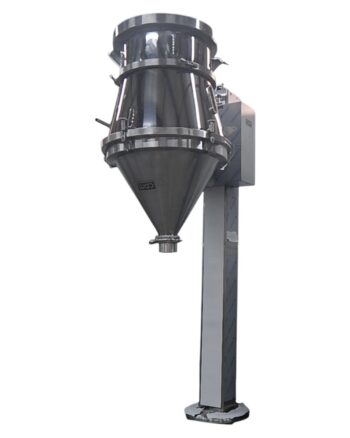
The workflow starts with getting the powder out of the vessel. CDM bowl lifts are purpose-built for this: the operator loads the bowl, the lift raises it to discharge height, and the inversion tips the contents out through a discharge cone into whatever sits below.
What makes the CDM bowl lift well-suited to this workflow isn’t just its lifting capacity: it’s the features that matter at the discharge point:
- 316 SS discharge cone polished to 20 Ra μin or better: a smooth, product-contact-grade surface that won’t harbor residue or contaminate the powder stream.
- Dust-tight mechanical bowl clamp with gasket seal. The connection between the bowl and the lift is sealed, so powder doesn’t escape during the lift and inversion sequence.
- 6″ pneumatic sanitary butterfly valve at the discharge: 316 SS with silicone gaskets, giving the operator controlled discharge rather than a dump. Open the valve, the powder flows. Close it, the flow stops. This matters when you’re feeding a sieve below at a controlled rate.
- 270° rotation with up to 72″ discharge reach. The lift can position the discharge point directly over the sieve inlet without repositioning the sieve.
- Optional pneumatic vibrator (tri-clamp mounted): for sticky or cohesive powders that don’t flow freely from the cone, the vibrator ensures complete discharge without manual intervention.
The bowl lift discharges downward through a controlled valve into whatever sits below it. In a typical setup, that’s a drum. But there’s room, literally, to put something smarter in between.
Step 2: The Inline Check Sieve: Russell Finex Compact Sieve
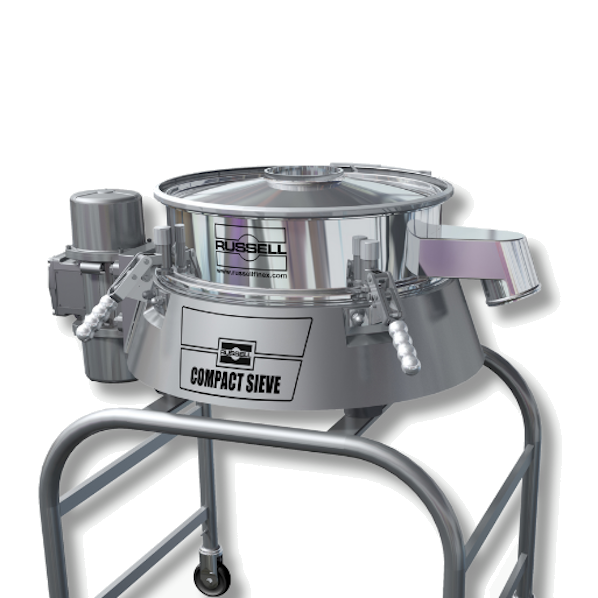
The Russell Finex Compact Sieve is a vibratory check screener. It doesn’t reduce particle size (that’s what a mill does). It verifies particle size. Good powder passes through the mesh; oversize particles, agglomerates, and foreign material are rejected. It’s a quality gate, not a process step.
That distinction matters. If your powder is already in spec coming out of the bowl, you don’t need a conical mill spinning at 400–1,000 rpm to force material through a screen. You need a simple, gentle vibration that confirms the powder is what you expect, and catches the exceptions before they reach the next operation.
Why the Compact Sieve fits this workflow
Small footprint, low profile. The Compact Sieve uses a side-mounted motor rather than a bottom-mounted design, which cuts the footprint roughly in half compared to a conventional vibratory sieve. The side-mounted motor keeps the overall height down, making it easy to position under a bowl lift discharge point where headroom is limited. This is both a space advantage and an ergonomic advantage. Operators can see and access the sieve without climbing or reaching.
Portable frame on wheels. Russell Finex offers a standard wheeled frame option, which is the key to this entire workflow. The sieve rolls into position between the bowl lift and the drum when you need it. When you don’t, it rolls out of the way. No permanent installation. No layout changes. No facility engineering drawings to revise. The sieve is a tool, not an infrastructure change.
Tool-free disassembly. No clamp rings, no wrenches. The entire screen change is tool-free with quick-release mechanisms. When it’s time to clean or swap mesh sizes between products, the operator disassembles the sieve in minutes without hunting for tools. In a multi-product facility running campaign changeovers, this directly impacts turnaround time.
Rubber vibration mounts instead of springs. The Compact Sieve uses rubber vibration mounts rather than traditional coil springs. It runs noticeably quieter, and it eliminates the pinch-point safety concerns that come with exposed springs. Cleaner look, safer operation: details that matter when your facility is being audited or toured.
Pharma-ready from the ground up. Polishable to 0.1 Ra, cGMP compliant, with full IQ/OQ/PQ documentation available. This is equipment designed for pharmaceutical manufacturing, not an industrial sieve adapted for it. The difference shows up in surface finish, documentation packages, and the validation effort required to qualify it.
The Workflow: Bowl to Sieve to Drum
Here’s what the integrated workflow looks like in practice:
- Load the bowl onto the CDM bowl lift. The mechanical clamp with dust-tight gasket secures the vessel.
- Lift and invert. The bowl lift raises the vessel and rotates it to discharge position: up to 270° rotation, up to 72″ reach.
- Roll the Compact Sieve into position between the discharge point and the receiving drum. The portable wheeled frame makes this a one-person, one-minute operation.
- Open the discharge valve. The 6″ sanitary butterfly valve on the CDM discharge cone feeds powder at a controlled rate into the sieve inlet.
- The sieve does its job. Good powder vibrates through the mesh into the drum below. Oversize particles, agglomerates, and any foreign material are retained on the screen for inspection or reprocessing.
- Roll the sieve out when the batch is done. Quick-release disassembly for cleaning. The drum is ready for the next step.
The entire screening step adds minutes, not hours. And it produces a documented quality checkpoint that would otherwise require manual sampling and lab analysis after the fact.
Why This Matters
In OSD manufacturing, every unit operation has defined material handling requirements and quality verification expectations. The industry consensus is clear: powder transfers are risk points, and screening between operations is a standard engineering control.
Most facilities know this. The challenge isn’t awareness: it’s implementation. Adding a permanent inline sieve means revising facility layouts, updating P&IDs, and potentially modifying structural supports for the additional equipment height. That’s why many facilities skip the screen and rely on downstream quality checks to catch problems after the fact.
The CDM bowl lift and Russell Finex Compact Sieve solve this differently. The bowl lift provides controlled, metered discharge through a sanitary valve, not an uncontrolled dump. The portable sieve wheels in when screening is needed and wheels out when it isn’t. Together, they add a quality checkpoint without adding infrastructure.
Designing a Powder Handling Workflow?
MHS Pharma represents CDM and Russell Finex across the full material handling and quality verification lifecycle. Whether you’re planning a new line or adding quality checkpoints to an existing process, we can help you design the workflow, not just the individual pieces.
Talk to MHS