
How to Contain a Roller Compactor: A Practical Guide from OEB 3 to OEB 5
Gerteis PACTOR plus ChargePoint PharmaSafe split butterfly valves: matched containment tiers from standard dry granulation through HPAPI.


How Do You Contain a Roller Compactor?
Short answer: with a Gerteis PACTOR matched to your compound’s OEB tier, and ChargePoint PharmaSafe split butterfly valves at the feed and discharge.
The compactor changes with potency. At OEB 3 it’s a standard machine. At OEB 4 it’s a machine with Gerteis’ Advanced OEL Design, or the Macro-Pactor C containment variant. At OEB 5 it’s the Ultra-Pactor, with a purpose-built integrated isolator. What doesn’t change is the transfer technology. ChargePoint split butterfly valves are the common thread at every tier, because that’s where the airborne exposure actually happens on a roller compaction line.
This is a practical guide to matching the two sides together, the compactor tier to your compound, the valve tier to your containment target, from standard dry granulation through HPAPI manufacturing.
The Compactor: Gerteis PACTOR Platform
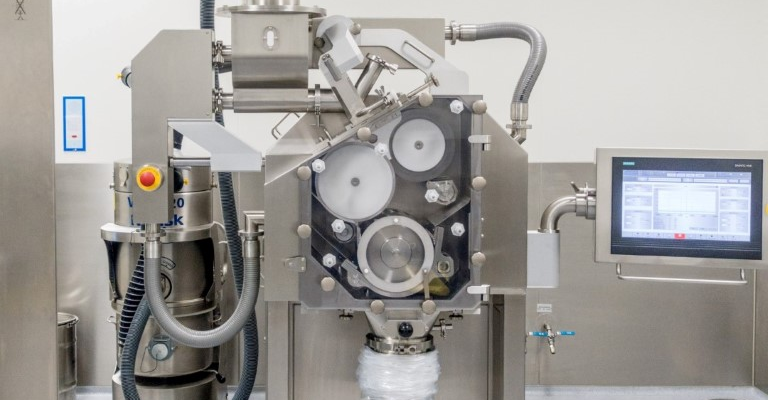
The PACTOR is closed by design: powder enters through a feed hopper, gets pressed between two rolls, and exits as ribbon that is immediately milled into granules. The two moments where airborne particulate is actively generated, the feed and the oscillating mill at the discharge, are the only transfer points that have to be contained externally. Every PACTOR ships with tri-clamp connections at both, ready to accept a ChargePoint split butterfly valve.
Mini-Pactor: Development and Small-Scale Production
Lab and pilot machine. Runs trials with as little as 10 g and scales up to 100 kg/h. Critical for potent compounds because early development batches are often milligram quantities of precious API.
- Standard OEL < 3 μg/m³ out of the box (OEB 3)
- Advanced OEL Design < 1 μg/m³ (OEB 4) as a factory option
- Split-valve-ready feed and discharge; WIP/CIP available
Macro-Pactor: Clinical and Commercial Production
Production sibling, 100 g trial quantities up to 400 kg/h. Shares identical roll geometry, press force, gap, and speed with the Mini-Pactor: process parameters developed in the lab transfer directly with a roughly 4× throughput increase from the wider 10 cm rolls.
- Macro-Pactor (standard): OEL < 3 μg/m³, with optional Advanced OEL Design down to < 1 μg/m³
- Macro-Pactor C (containment variant): OEB 4 as standard (< 1 μg/m³), with a through-the-wall mount option. Feed and discharge designed for integration with high-OEB split valves.
Ultra-Pactor: HPAPI Production with Integrated Isolator
Gerteis’ ultra-high-containment production machine. Throughput up to 400 kg/h with a 10 g trial minimum, same scale-up story as the Macro-Pactor, but with a purpose-built Gerteis isolator engineered around the compactor from the ground up.
- Containment < 0.1 μg/m³ (OEB 5)
- Fully automated WIP/CIP inside the containment envelope
- Rapid transfer port (Ø 350 mm) for samples and parts
- Split HMI: operator interface outside the containment zone
- Monitored fire-wall seals and online pressure monitoring
- Push/push safe-change filter system
- Split butterfly valve integration on feed and discharge (ChargePoint PharmaSafe / PharmaSafe Pro)
The Transfer Valves: ChargePoint PharmaSafe
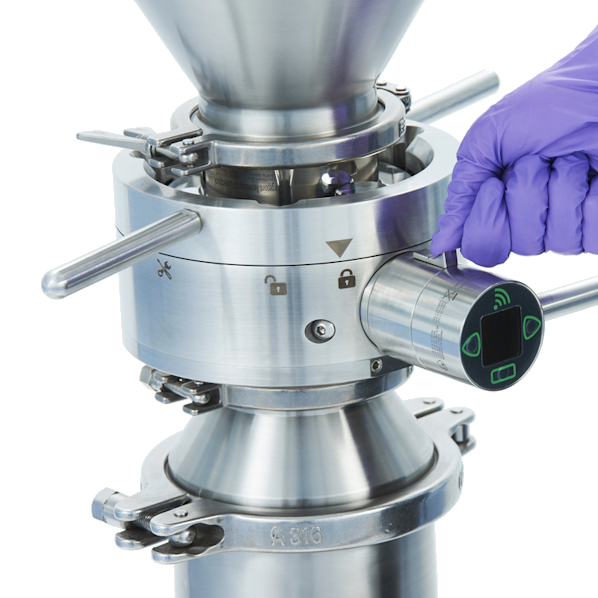
The split butterfly valve is the technology that closes the transfer points on a roller compaction line at every tier: from a standard OEB 3 line up to the Ultra-Pactor’s OEB 5 installation. A single butterfly disc is split into two halves: the active (alpha) mounts permanently to the compactor port, the passive (beta) travels with the powder container. Neither opens independently. Only when docked do the disc halves combine into a single sealed butterfly that can rotate open for transfer. When undocked, product-contact faces are sealed back inside their housings: no open powder at any point.
PharmaSafe (Standard): Down to 1 μg/m³
Achieves OEB 4 containment through the split valve geometry alone, no extraction required. DN50 (2″) through DN250 (10″), pressure-rated to 6 bar (10 bar optional), manual, semi-automatic, or fully automatic. Paired with a standard or Advanced-OEL PACTOR, or a Macro-Pactor C, the standard PharmaSafe on feed and discharge is a complete containment solution for OEB 3 and OEB 4 compounds.
PharmaSafe Pro + Extraction Skid: Down to 0.1 μg/m³
At OEB 5, the containment ceiling of a split butterfly valve alone is set by what the industry literature calls the “ring of concern”: the narrow annular region where the two disc halves meet. For OEB 4 that’s within the limit; for sub-microgram OEB 5 it has to be actively managed. The Pro valve adds an extraction port on the outer body, and the Extraction Skid, a compact, fully pneumatic HEPA unit, connects via a 4 m hose and draws low-volume air through the valve interface during and after docking. Any residual particulate is captured before it can become airborne.
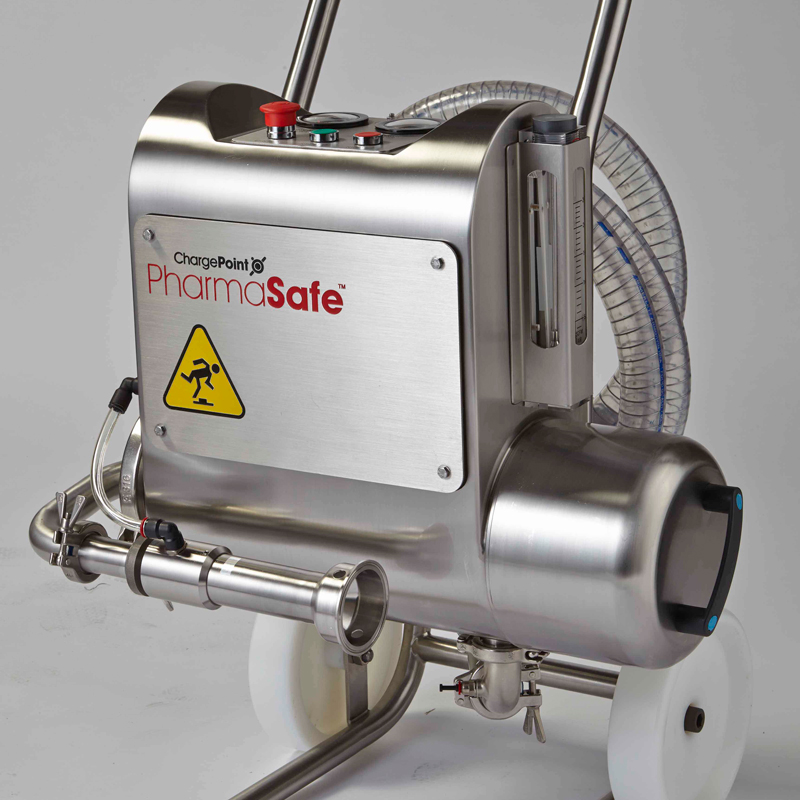
- Dual H14 HEPA filters (EN1822) with independent differential pressure gauges
- Minimum 1,300 l/min extraction rate through the valve interface
- Fully pneumatic: no electrical supply, compressed air at 6 bar. ATEX version available.
- Safe-change filter bag-out port
- Wall-mounted (40 kg), floor-standing (62 kg), or mobile on castors (62 kg)
The Pro valve with the Extraction Skid is the transfer technology specified on the Ultra-Pactor for OEB 5 operation: the same ChargePoint split butterfly valve principle used at OEB 3 and OEB 4, upgraded with active extraction to manage the ring of concern at sub-microgram levels.
Matched Across Tiers
Both Gerteis and ChargePoint build tiered containment mapped to the same OEL breakpoints. That eliminates the single most common failure mode in containment specification: matched headline numbers on individual components, mismatched containment at the interfaces between them.
| Containment Target | Compactor | Transfer Valves | Extraction |
|---|---|---|---|
| < 3 μg/m³ (OEB 3) | Mini-Pactor / Macro-Pactor (standard) | PharmaSafe (standard) | Not required |
| < 1 μg/m³ (OEB 4) | Mini/Macro-Pactor with Advanced OEL, or Macro-Pactor C | PharmaSafe (standard) | Not required |
| < 0.1 μg/m³ (OEB 5) | Ultra-Pactor (integrated isolator) | PharmaSafe Pro | PharmaSafe Extraction Skid |
Specifying a Contained Dry Granulation Line?
MHS Pharma represents both Gerteis and ChargePoint Technology across North America. Whether you’re moving a potent compound from Mini-Pactor development into Macro-Pactor or Ultra-Pactor production, or retrofitting contained transfer valves onto an existing compactor, we can help you match the right equipment tier to your compound’s OEL.
Related: our overview of pharmaceutical powder containment covers containment approaches across transfer, milling, granulation, and sieving.
Talk to MHS